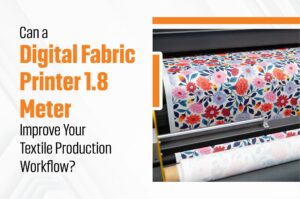
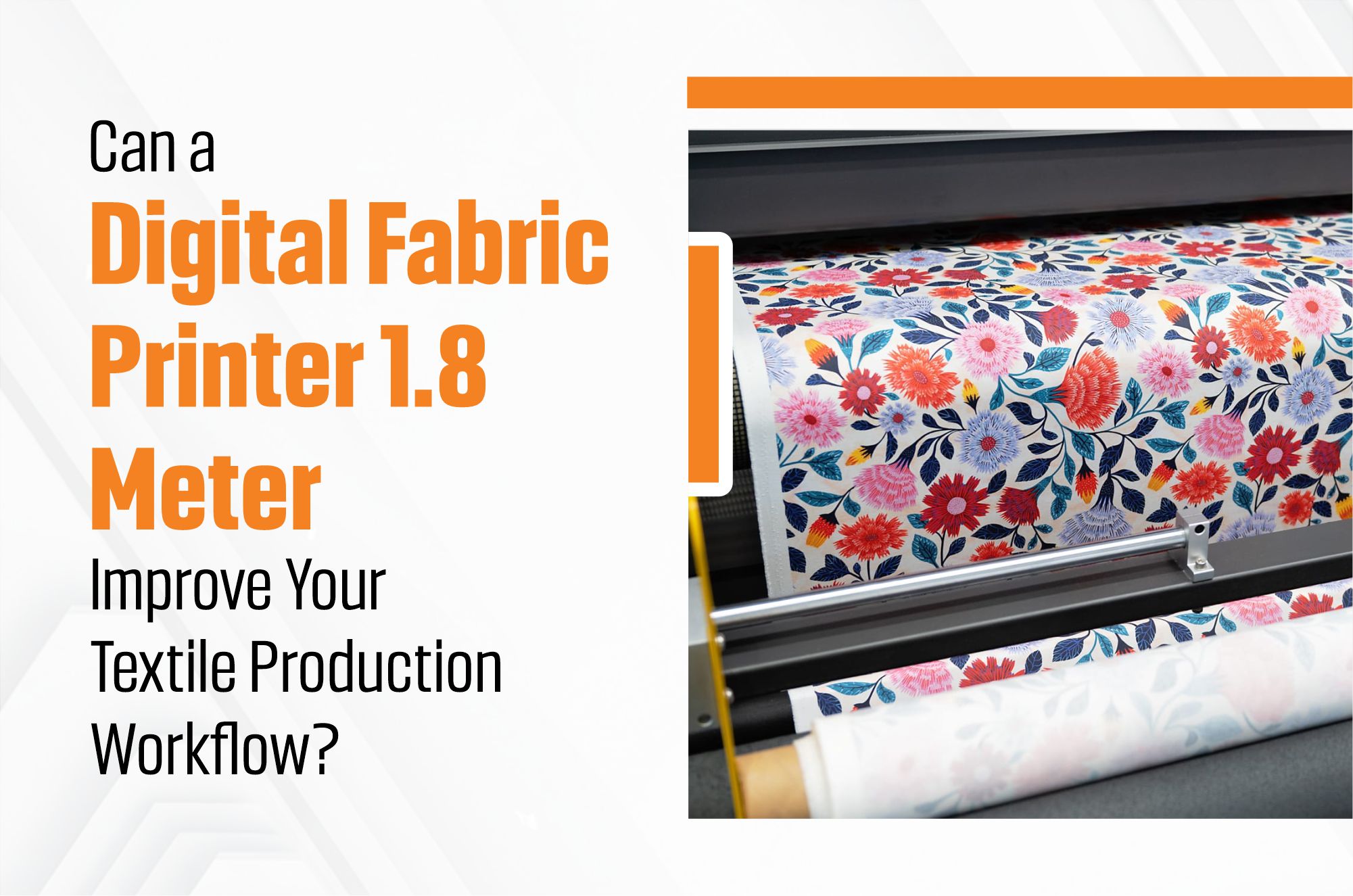
In textile printing, a good design is only part of the job. The real challenge is getting that design up to production in fabric without holding up the rest of your production up. This is why companies are shifting to print workflow management solutions that can provide them with greater control over their printing process, as the orders become more customised and the turnaround time gets shorter. A digital fabric printer 1.8 meter can be used to make roll based printing, uniformity and a simpler manufacturing process available in a single unit. However, what impact can it really have? Now, let’s consider how a 1.8 meter printer can streamline workflow and when companies should consider their investment.
 Look at the Workflow Before Looking at the Machine
Previously it’s important to consider where in your textile workflow time is being lost before selecting a printer. Are there any fabrics waiting to be printed? Is it hard to plan custom orders? Does reprinting slow down the completion of a project? These gaps can provide more information about the machine necessary than a specification sheet. The typical textile work flow consists of design preparation, loading fabrics, printing the fabric, drying, take up, finishing and delivery. If the printing slowness or trouble occurs, it can drag on every stage thereafter. This is where the decision to buy the right digital fabric printer 1.8 meter is not just about buying the machine, it becomes a production choice. The printer should be able to support your fabric width, volume of orders, print quality, and turnaround time.
Where Can a 1.8 Meter Digital Fabric Printer Make the Biggest Difference?
The value of a digital fabric printer 1.8 meter is not simply its wider printing area. The key benefit will be how that working width fits into your day to day production. If you are regularly working on larger rolls 1.8 meters wide, a properly sized format for printing will help to plan the printing process.
It allows you to work on larger designs and endless print jobs without having to treat anything as a small print job. It might also come in handy when customers are calling for more design variations. Digital printing enables artwork to be changed between orders without having to make a new printing setup for each order. This provides businesses with greater flexibility in dealing with custom designs, samples, seasonal collections, or smaller production runs.
But wider does not necessarily mean better. The extra width isn’t going to be of much benefit if most of your projects are made with thin fabrics. It will depend upon the kind of products you print and the orders you have that are regular. That’s why the 1.8m working width should not be considered a machine specification but rather a workflow decision.
From Artwork to Fabric: What Happens Inside the Printing Workflow
Flax printing is a smooth process that begins before the textile is loaded into the machine. When the artwork is ready, it is fed into the RIP software and the design is converted into printable information. The fabric is then laid on top of and pushed into the printer using the settings determined for the task. The printhead(s) in the machine deposit controlled amounts of ink on the fabric to create the pattern. Fine detail, colour transitions and overall image quality can be controlled using technologies like Epson DX5 or DX7 printheads and greyscale printing.
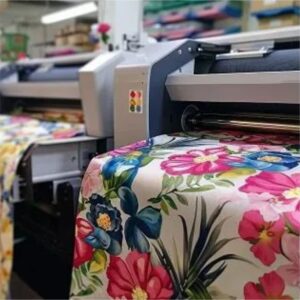
The process doesn’t end once the design is printed. Other aspects of production include drying and fabric take up. An IR drying system can be used during the drying stage and the automatic take up can be employed during the job to gather the printed material. This is a connected workflow for a number of reasons: each step influences the next. Combined with the creativity involved in preparing artwork, the printing phase, the drying process, and the handling of the fabric, it is possible for the operators to dedicate less time to interruptions and more to getting the job done.
Speed is Not Just a Numbers Game
When looking at fabric printers, one of the first specifications that a buyer would consider is production speed. However, the fastest machine listed is not necessarily the machine you’ll use for each order. The balance between speed and output quality can vary through changes in print resolution and pass settings. The setting for a detailed textile design is likely to vary from that of a simpler design, where speed of production is more important. Hence, the mode of choice can aid the business in quality control and production time. For instance, our digital fabric printer 1.8 meter is specified with different production speeds for different modes of printing. This provides the operator with flexibility in choosing an appropriate setting for the job.
The better question is not just ‘how quickly can the printer operate? It’s “Which print setting would give me the correct output in the time I have to produce it in? This method enables companies to calculate realistic production capacity rather than a max value.

Where Does a Digital Fabric Printer 1.8 Meter Fit in Different Textile Businesses?
A digital fabric printer 1.8 meter can fit into various textile processes but its worth varies according to the sort of work a business deals with. A textile printing company can utilize the machine for regular roll printing, and a fashion company requires it for altering designs and custom-made fabric needs.
A digital print fabric 1.8 is an advantage for businesses that also handle custom textile orders because it can make the production of a design more controlled regarding the timing and the way it is produced. The business doesn’t have to schedule all jobs according to an outside print run, but rather make good printing runs to suit the business’s own needs. Businesses involved in home furnishing fabrics, promotional textiles and other appropriate polyester based fabrics could also consider the 1.8 m digital fabric printer. But it is always best to test your fabric before choosing a machine. All of these processes must cooperate with the ink system, fabric type, printing method and finishing process.
Thus, the application of a digital fabric printer 1.8m is not restricted to a certain field of industry. It is characterized as a machine that fits the fabric needs, order sequence, production quantity and output of the business.
What Should You Check Before Investing in a Digital Fabric Printer 1.8 Meter?
Choosing a digital fabric printer 1.8 meter should start with your production requirements, not just the machine specifications. There are a couple of ways to determine if the format is appropriate for your business. The first thing to do is to measure the width of fabric. The 1.8 meter format might be useful for production flexibility if this is your normal work.
Then, check your average order value. When determining a digital fabric printer 1.8 m, think in terms of how much fabric you are going to use for printing, not an amount that is advertised. The quality of the prints is another factor to consider. Take into account the degree of detail, colour accuracy and uniformity your customers are looking for in the finished fabric. Don’t underestimate material compatibility. Materials, inks, print method and finish should be appropriate to the products to be printed.
Last, but not least, think about the typical workflow. A tool, such as a digital fabric printer 1.8 meter, that offers the functionality your team needs, and the media handling, drying, and maintenance options are right for it, can be more useful when it fits how your team works.
Why the BPI 1.8 Meter Digital Fabric Printer Can Fit a Production-Focused Workflow
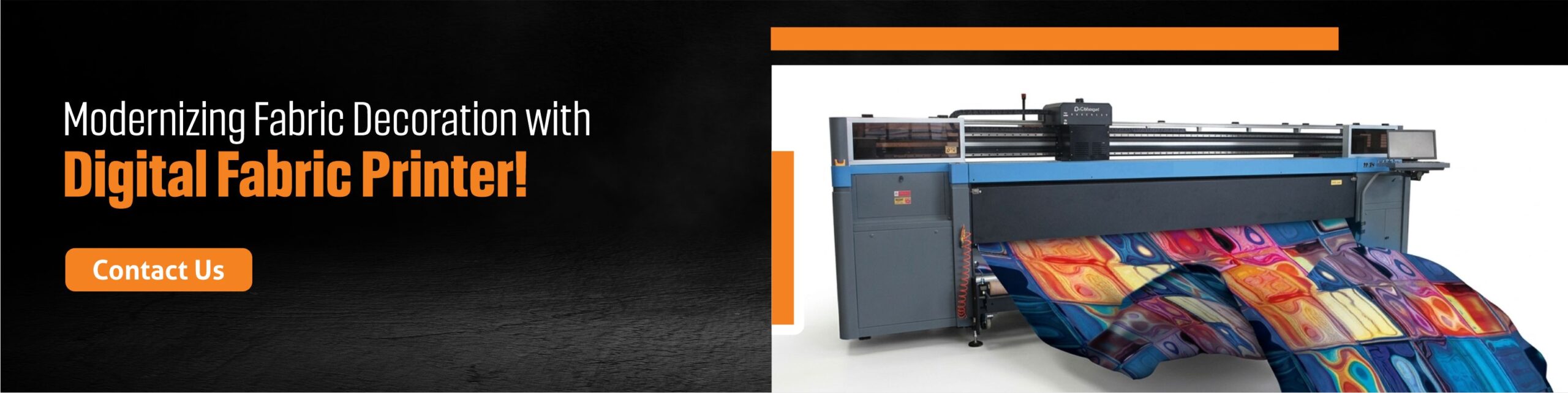
If the production requirements are defined, then machine specifications can be easily evaluated. BPI 1.8m Digital Fabric Printer is based on the most important steps of a roll based textile printing workflow including fabric handling, printing and drying. The digital fabric printer 1.8 m is a printer that creates a working width of 1.8 m for appropriate textile applications. It comes in a printhead configuration of Epson DX5/DX7 for detailed digital printing and GZ greyscale technology for better ink droplet placement control to produce smoother images.
It also has a bulk ink supply system, automatic capping and wiping, and automatic take up for regular production. The features are relevant because they relate directly to the common functions performed by the operator and not just to a machine brochure. The BPI 1.8 meter digital fabric printer is also equipped with the anti-crash system and IR drying function, which helps to solve the problems of fabric handling and machine working while making products. These can be used to combine multiple stages of the printing process in a single, organized system, using the correct fabric, ink and print settings. What’s important, however, is to evaluate a fabric printer 1.8 meter based on these features, rather than on their specifications alone, and determine whether they align with your production requirements.
Conclusion
A digital fabric printer 1.8 meter can improve a textile workflow, but the machine itself is only one part of the equation. True benefits materialize when the printer, the operator, fabric handling, artwork preparation and finishing processes are coordinated as a single system. If you’re going to invest, consider the types of jobs that you’re getting most frequently.
Review fabric width, print volume/amount, quality specification, lead time and finishing process. This will aid you to set print parameters and actual production capacity, not based on assumptions. If you want your textile business to grow, then you should aim to develop a predictable, easy to manage workflow. By combining the right digital fabric printer 1.8 meter and the right materials and production process, businesses can expect to have better control over their printing processes and more confidence to meet evolving customer needs.