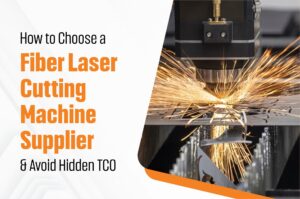
When you need to find a reliable fiber laser cutting machine supplier, you can feel overwhelmed. With dozens of manufacturers making bold claims about cut speeds, laser power, and rock bottom prices, how do you know which company actually delivers on its promises? Buying a fiber laser is a major capital investment for any shop floor. If you pick the wrong fiber laser cutting machine supplier, you do not just lose money on the initial machine. You end up stuck with frequent downtime, missing spare parts, and poor cut quality that burns through your profits. This step by step guide breaks down how to vet suppliers, evaluate machine specs, calculate operating costs, and choose a partner that keeps your shop running profitably for years.
 Key Takeaways Before You Buy
• Look past the sticker price: The purchase price is only a small fraction of what you spend over a five year period.
• Know your laser source: The brand powering the beam (like IPG, Raycus, or MAX) dictates machine stability and lifespan.
• Check local service support: A great machine is useless if you have to wait three weeks for a technician to replace a failed component.
• Ask for real cut tests: Always make a prospective fiber laser cutting machine supplier cut your specific shop materials before you sign a contract.
Quick Comparison of Top Supplier Tiers
Not every shop needs a multi million dollar automated setup. Similarly, an enterprise production factory cannot rely on a basic budget cutter. When you evaluate a fiber laser cutting machine supplier, you will notice they generally fall into three distinct market tiers based on engineering focus, manufacturing origin, and regional support capabilities. Knowing which tier fits your budget and production volume saves you time during the quote phase.
Global Supplier Tier Matrix
| Supplier Tier | Manufacturing & Market Focus | Upfront Investment | Target Uptime & ROI | Best Suited For |
| Tier 1: High Automation OEMs & Regional Distributors | Legacy machine builders and established international suppliers (such as Business Point International in the Middle East) providing localized support | High ($$$$) | Maximum uptime, 24/7 continuous production, rapid local field service | Aerospace, automotive suppliers, structural steel, and regional smart factories |
| Tier 2: Global High ROI Integrators | International export manufacturers balancing premium component sourcing with lean production | Moderate to High ($$$) | Fast payback period, strong balance of power and cost | Growing mid to large job shops and structural steel fabricators |
| Tier 3: Value & Regional Integrators | Regional assembly shops using standardized white label components | Budget Friendly ($$) | Low to medium volume, lower initial capital exposure | Small job shops, prototyping, and thin gauge sheet metal cutting |
Role of Regional After Sales Support in the UAE & Middle East
A major factor when choosing a Tier 1 or high ROI fiber laser cutting machine supplier in regions like the UAE, Saudi Arabia, and the broader Middle East is localized after sales service support. Relying solely on overseas remote diagnostics can cause weeks of costly downtime if a optical component or servo drive fails. Established regional partners, such as Business Point International, bridge this gap by providing:
• On-Site Field Engineers: Local Arabic and English speaking technicians who can dispatch to job sites within 24 to 48 hours.
• Local Spare Parts Hubs: Readily available stock of consumables (lenses, nozzles, ceramic rings) and high value spare parts directly within the UAE to avoid import delays.
• Installation & Operator Training: Hands-on commissioning and nesting software training tailored to local workforce requirements.
How to Choose Your Tier
• Go with Tier 1 (or trusted regional suppliers like Business Point International) if: You run multi shift operations in the UAE or Middle East, require continuous reliability, and need guaranteed local technical dispatch.
• Go with Tier 2 if: You need high power processing (such as 6kW to 20kW) for heavy structural metal, but you want a faster return on investment without paying high legacy brand premiums.
• Go with Tier 3 if: You cut light sheet metal under 6mm, run your machine fewer than 40 hours a week, and have in-house technicians who can handle basic troubleshooting.
The 5 Crucial Factors to Evaluate Every Supplier
Choosing a fiber laser cutting machine supplier is not just about comparing equipment prices. You are selecting a long term partner for your production floor. To ensure you make a safe investment, evaluate every prospective vendor against these five key operational factors before requesting a final quote.
Factor 1: Transparency in Laser Source Sourcing
The laser source is the heart of your machine. It generates the beam and determines how reliably you can cut over several years.
A reputable fiber laser cutting machine supplier will be completely transparent about the exact manufacturer, model, and wattage of the laser source inside their cabinet.
• Top Tier Global Sources: Brands like IPG Photonics, nLIGHT, and Coherent offer high beam stability and longer operational lifespans (often exceeding 100,000 hours).
• Cost Effective Sources: Brands like Raycus and MAX Photonics offer strong value and lower replacement costs for standard shop cutting applications.
• Red Flag: Be cautious if a supplier uses a generic label or refuses to state the exact laser source brand in writing.
Factor 2: Machine Bed Construction & Stress Relief
A laser cutter must maintain microscopic accuracy while moving heavy cutting heads at high speeds. If the machine frame warps over time due to mechanical vibration and heat, your cut quality drops.
• Heavy Duty Welded Frame: Look for machine beds made from high tensile steel plates or heavy mortise and tenon structures.
• Annealing Heat Treatment: Ask if the frame undergoes high temperature stress relief annealing (typically around 600°C) during manufacturing. This process prevents the metal frame from warping or expanding out of alignment years down the road.
• Aviation Grade Gantry: Aluminum alloy gantries keep the moving parts light and rigid, allowing faster acceleration (>1.5\G ) without shaking the bed.
Factor 3: Regional After Sales Service & Spare Parts Stock
Machine downtime is the biggest hidden cost in metal fabrication. A low machine price quickly turns into an expensive mistake if a failed component stops your shop floor for weeks. When evaluating a fiber laser cutting machine supplier, demand clear answers about their service infrastructure:
• Local Technician Dispatch: Can they send a qualified field engineer to your facility within 24 to 48 hours?
• Consumable Inventory: Do they maintain a local warehouse with protective lenses, nozzles, ceramic rings, and cutting heads, or do parts ship from overseas?
• Training & Onboarding: Does the vendor include comprehensive, hands-on operator training for your workforce during installation?
Factor 4: Software Ecosystem & Nesting Capabilities
The hardware cuts the metal, but the software determines how efficiently you use your material and labor.
• User-Friendly CNC Interface: Look for industry standard control systems (such as CypCut, HypCut, or proprietary native software) that operators can learn quickly.
• Automatic Nesting: Smart nesting software packs your parts tightly onto the sheet, reducing metal scrap by 10% to 15% on every batch.
• CAD/CAM Compatibility: Ensure the machine imports common file formats (DXF, DWG, STEP) directly without conversion errors.
Factor 5: Real Material Cut Testing & Quality Verification
Never buy a machine based purely on spec sheets or promotional videos. A trustworthy fiber laser cutting machine supplier will happily run cut tests using your exact material samples.
• Send Your Files: Provide your own CAD drawings with your typical sheet thicknesses and metal grades (stainless steel, aluminum, brass, or carbon steel).
• Inspect the Edge Quality: Check the finished parts for dross, burrs, edge taper, and heat distortion.
• Verify Speed Claims: Confirm the exact assist gas used (N2, O2, or compressed air) to reach the quoted cutting speed.

Laser Power Sizing vs. Material Thickness
One of the biggest decisions you will make with your fiber laser cutting machine supplier is selecting the right laser power output. Selecting machinery with insufficient wattage will affect the production capacity and result in slow cutting on thick metals. In contrast, having excess power causes unnecessary expenses for the purchase of the machinery as well as increased electricity bills.
Material Thickness & Power Sizing Matrix
Use this general guideline when matching wattage to your primary production materials:
| Laser Power (Wattage) | Mild Steel (Max Thickness) | Stainless Steel (Max Thickness) | Aluminum (Max Thickness) | Ideal Production Application |
| 1.5kW – 3kW | Up to 16mm – 20mm | Up to 6mm – 8mm | Up to 6mm | Light sheet metal fabrication, ductwork, kitchenware, thin enclosures |
| 6kW – 8kW | Up to 25mm | Up to 16mm – 20mm | Up to 16mm | Mid tier job shops cutting mixed metal profiles, electrical cabinets |
| 12kW – 20kW | Up to 40mm – 50mm | Up to 30mm – 40mm | Up to 30mm | High speed structural steel processing, heavy machinery, ship components |
| 30kW – 60kW+ | 50mm+ | 50mm+ | 40mm+ | Heavy plate processing yards, thick structural beam cutting, specialized industrial manufacturing |
Key Rules for Selecting Your Laser Power
Identify Your 80% Workload: Do not size your machine based on the thickest plate you cut once a year. Size it for the material thickness that occupies 80% of your weekly production.
• Factor in Assist Gas Selection: Nitrogen (N2) produces clean, oxide free edges on stainless steel and aluminum, but requires higher laser power. Oxygen (O2) uses a chemical reaction to burn through thick carbon steel with less wattage, but leaves an oxide layer that may require cleaning before painting.
• Consider Compressed Air Cutting: Modern high power lasers (6kW and above) can use high pressure compressed shop air to cut thin to medium steel. This dramatically reduces assist gas expenses over time.
Calculating Total Cost of Ownership (TCO)
The sticker price on a quotation represents only a portion of what you will actually spend over a machine’s operational lifecycle. A reliable fiber laser cutting machine supplier will help you calculate your Total Cost of Ownership (TCO) so you can accurately forecast your profit margins.
Total Cost Breakdown: Equipment vs. Operational Expenses
| Expense Category | Cost Type | What It Includes | Cost Optimization Tips |
| Initial Machinery Cost | Fixed / Capital | Machine frame, laser source, cutting head, chiller, software licenses | Balance upfront cost against long term build quality and warranty depth |
| Electricity Consumption | Variable / Monthly | Main CNC unit, laser generator power draw, water chiller, dust collector | Fiber lasers yield ~35–40% wall plug efficiency, using up to 70% less energy than older CO2 lasers |
| Assist Gas Expenses | Variable / Monthly | Bulk Nitrogen (N2), Oxygen (O2), or air compressor power | Use high pressure compressed shop air for thin gauge materials to save up to 75% on gas costs |
| Consumables & Wear Items | Variable / Ongoing | Protective lenses, copper nozzles, ceramic rings, filter elements | Buy consumable multipacks locally to avoid emergency shipping fees and production stops |
| Maintenance & Labor | Variable / Yearly | Scheduled optical cleaning, rail lubrication, operator hourly rates | Implement a strict daily maintenance log to prevent costly component failure |
The Simple Hourly Cost Formula
Before signing a contract, estimate your hourly running cost using this basic calculation:
{Hourly Running Cost} = {Electricity (kW/h)} + {Assist Gas (L/min)} + {Consumable Wear} + {Operator Labor}
• Pro Tip: Fiber laser systems require zero beam mirror alignments and eliminate internal laser gas charges, reducing overall ongoing maintenance costs compared to legacy cutting systems.
Red Flags to Avoid Before Placing an Order
Even if a quote looks fantastic on paper, certain warning signs indicate a vendor may cause headaches later on. Protect your capital investment by keeping an eye out for these five critical red flags:
1. Unclear Sub-Component Sourcing
If a prospective fiber laser cutting machine supplier uses vague terms like “high precision European style CNC” or “custom industrial cutting head” without listing actual brand names, be cautious. Reputable suppliers specify every major subsystem (such as IPG laser generators, Precitec cutting heads, and Yaskawa servo drives) directly in their written quotations.
2. No Local or Regional Field Service Footprint
Relying solely on remote messaging apps or international phone support is risky for an active shop floor. If a supplier does not maintain local field technicians or an established service office in your country or region, such as the UAE and GCC. A minor electrical glitch could halt your production for weeks.
3. Exaggerated Cut Speed & Thickness Claims
Some vendors quote maximum cut speeds based on ultra thin sheet metal processed with expensive high purity Nitrogen gas. Always ask for real world cutting speed tables that detail:
• Metal type and exact thickness (mm)
• Assist gas type (N2, O2, or compressed air) and consumption rates
• Finished edge quality expectations (dross free vs. rough production cut)
4. Refusal to Conduct Factory Acceptance Testing (FAT)
Never place a final order without verifying machine performance. A reliable supplier will gladly record a live video demo or invite you to their facility/showroom to cut your specific material samples before shipping.
5. Unbalanced Warranty Terms
Read the fine print regarding warranty coverage. A standard warranty should cover core components (laser source, CNC controller, cutting head, and machine bed) for at least 2 to 3 years. Be wary of contracts that offer long warranties on the frame but exclude high value optoelectronic parts.
Why Choose Business Point International (BPI) as Your Fiber Laser Supplier in the UAE & GCC
Selecting the right machine hardware is only half the battle; finding a trustworthy regional partner ensures your investment yields continuous returns. Business Point International has established itself as a premier industrial machinery distributor across the UAE, Saudi Arabia, and the broader Middle East. Rather than dealing with long overseas shipping delays or remote diagnostic support, BPI provides a localized, end to end ecosystem engineered specifically for fabricators operating in the GCC region.
Key Advantages of Partnering with BPI
Localized Field Engineering & Fast Dispatch: BPI bridges the gap between international manufacturing and local shop floor needs. Based directly in the UAE, BPI dispatches qualified field service technicians for rapid on-site commissioning, preventative maintenance, and emergency troubleshooting.
Regional Spare Parts Inventory: Avoid weeks of costly downtime waiting for customs clearances. BPI maintains an extensive regional stock of essential laser consumables (protective lenses, copper nozzles, ceramic rings) and critical drive components.
Annealed Frame Durability & Premium Components: BPI fiber lasers feature heavy duty welded beds that undergo high temperature stress relief annealing to prevent frame warping over years of heavy plate loading. Crucial subsystems are integrated with global leaders, including IPG and Raycus laser sources, Bystronic cutting heads, and Schneider electrical systems.
Comprehensive Operator Training: BPI ensures your workforce hits the ground running by providing hands-on training for CAD/CAM software nesting, cutting parameters, and routine machine safety.
BPI’s Featured Fiber Laser Machine Lineup
BPI offers a complete portfolio of fiber laser solutions tailored to diverse manufacturing scale, budget, and material profile needs:
| BPI Machine Series | Power Options | Key Operational Features | Ideal Industrial Application |
| D-Power Series | 3,000W – 30,000W | Open/Enclosed format options, smart auto cleaning cutting heads, 1.5G acceleration, and anti collision safety sensors. | Entry to mid level job shops, sheet metal enclosures, and general metal fabrication. |
| D-Win Series | 3,000W – 12,000W | Open and closed bed designs with automatic dual shuttle tables for seamless material loading/unloading. | High efficiency sheet metal processing requiring continuous batch production. |
| D-Soar Plus (G & PG) Series | 12,000W – 60,000W | Ultra high power system featuring advanced 3D bevel cutting, 2.8G acceleration, and bus controller integration. | Heavy structural steel, thick plate processing, shipbuilding, and 24/7 automated industrial applications. |
| Tube & Pipe / Combined Series | 1,500W – 12,000W | Specialized rotary chuck systems designed for round, square, rectangular, and profile pipe processing. | Structural steel framing, architectural metalwork, and pipeline manufacturing. |
Real World Cutting Capabilities
BPI fiber laser systems process a wide range of ferrous and non ferrous alloys with high beam stability:
• Carbon / Mild Steel: Clean, high speed piercing and cutting up to 50mm+ thicknesses.
• Stainless Steel: Oxide free Nitrogen assist cutting for pristine, burr free edge finishes.
• Reflective Alloys: High energy beam density designed to process copper, brass, and aluminum without back reflection damage.
Final Checklist: How to Decide on Your Supplier
Choosing the right fiber laser cutting machine supplier comes down to balancing build quality, local technical support, and total operating cost:
• Define Your Core Need: Choose a machine size and laser power based on the metal thickness that makes up 80% of your daily workload.
• Audit the Bill of Materials: Ensure all laser sources, CNC controllers, motion guides, and cutting heads come from recognized manufacturers.
• Verify Service Availability: Partner with an established regional supplier such as Business Point International in the Middle East to ensure rapid technician dispatch, on-site commissioning, and local spare parts inventory.
• Run Real Material Tests: Inspect edge smoothness, dross formation, and dimensional accuracy on your own test parts before sending a deposit.
By focusing on total cost of ownership and technical service support rather than upfront price alone, you ensure your fiber laser investment delivers clean cuts, maximum uptime, and consistent profitability for years to come.